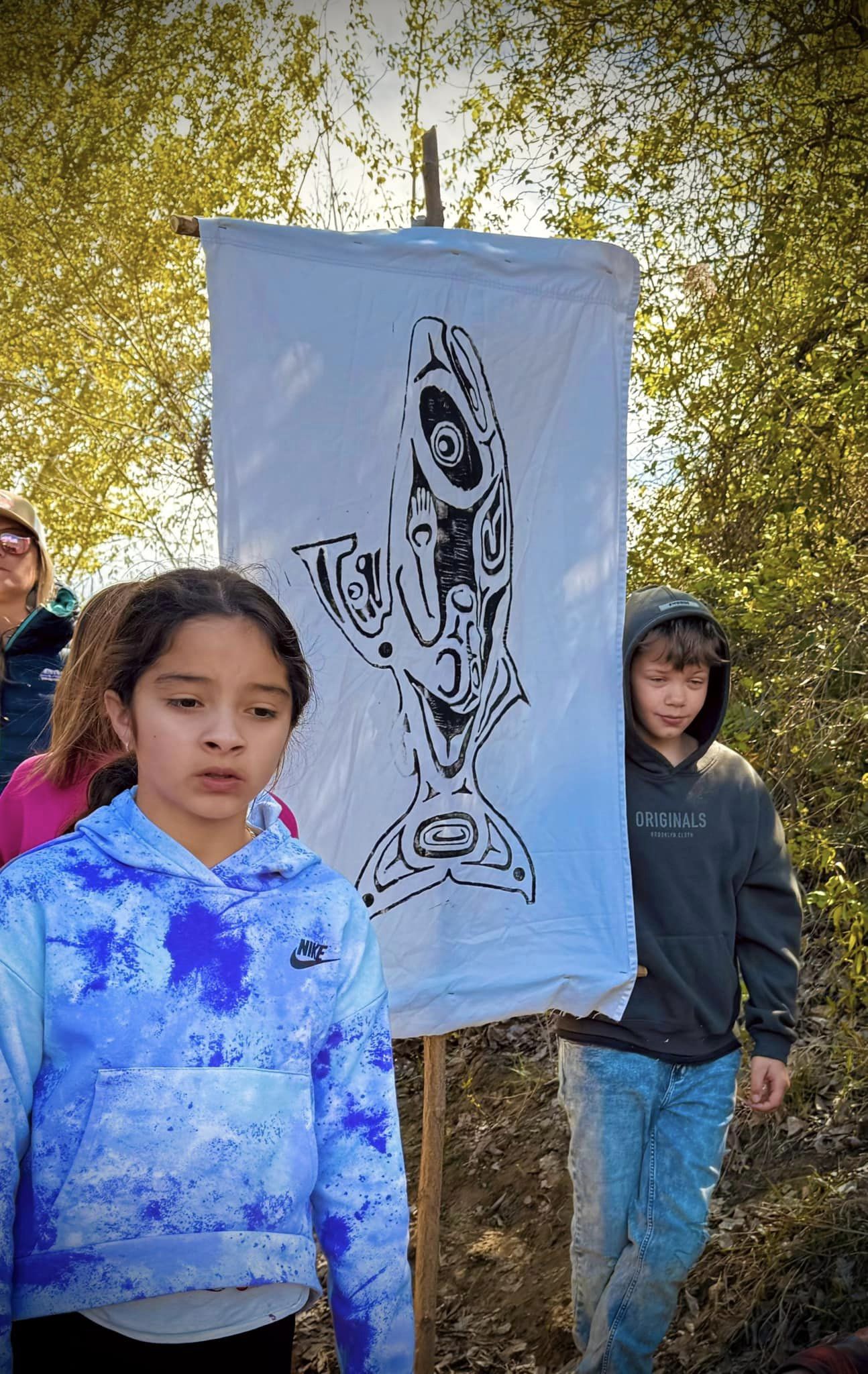

Water is the first medicine. It moves through all of us, connects all of us, and it asked us to protect it long before we had a word like conservation. At Learning to Heal (mypənum ṕʔax), we don’t care for the water because it’s a resource. We care for it because it’s a relative — sic cwix (New River), the Similkameen, the rivers that have been family since before our ancestors had to fight to keep them whole.
This is a starting place. Whether you’re a parent reading at a kitchen table, a teacher building a unit, a youth ready to find your voice, or an organization wanting to walk this path alongside your community — these are tools to begin learning water protection the way Indigenous peoples have always understood it: as kinship, as responsibility, as a story still being told.
We’ve gathered these by age and stage so you can find your way in. Take what fits. Move at the pace of the season you’re in.
For the Little Learners (Ages 4–8)
This is where the relationship begins — before policy, before protest, with a child learning that water sings, that water is alive, that water is owed care.
We Are Water Protectors by Carole Lindstrom (Turtle Mountain Ojibwe), illustrated by Michaela Goade (Tlingit, Haida) — The Caldecott Medal winner, written in response to Standing Rock. A young Ojibwe girl learns from her grandmother that water is sacred, and finds her voice to defend it against a “black snake.” Poetic, fierce, and made for reading aloud. Many editions include a Water Protector Pledge children can take.
ISBN: 978-1-250-20355-7
Free downloadable activity kit (with the Water Protector Pledge)
The Water Walker by Joanne Robertson (Ojibwe) — The true story of Nokomis Josephine Mandamin, the Ojibwe grandmother who walked the entire perimeter of the Great Lakes to protect Nibi (water) for future generations. A real water protector, told in a way a small child can hold.
ISBN: 978-1-927583-94-4
Order through your library or a Native-owned bookseller such as Birchbark Books: https://birchbarkbooks.com
Nibi’s Water Song by Sunshine Tenasco (Anishinaabe), illustrated by Chief Lady Bird — A girl named Nibi goes searching for clean water and refuses to give up. An honest, child-friendly doorway into the reality that not every community has safe water — and what it means to demand better.
ISBN: 978-1-4431-7407-7 (Scholastic Canada)
The Water Sings to suliʔ by Harron Hall (Syilx) — Part of the Follow the Water series, written from a Syilx Okanagan perspective, weaving nsyilxcən language into a story of a child learning to hear the song of water. Especially close to home for our community, with the language carried right inside the pages.
Published by Theytus Books — the oldest Indigenous-owned publisher in Canada, located in Syilx territory.
→ Series overview
→ Order the series (Syilx-authored, Indigenous-owned distributor)
A note for grown-ups reading along: sit with the hard parts. When a book names that some communities don’t have clean water, sit there for a moment. Let the child feel it. Then turn the page toward what people are doing about it. Both things are true at once — the wound and the medicine.
For Curious Kids (Ages 9–13)
Now the questions get bigger. Why is the water in danger? Who decides?What can I do? This is the age where a child starts to understand they have agency — and the stories meet them there.
Young Water Protectors: A Story About Standing Rock by Aslan Tudor (Lipan Apache), written when he was ten years old — A true account of a child who was actually at the Oceti Sakowin Camp at Standing Rock, told in his own voice, illustrated with real photographs. There’s nothing more powerful for a young person than seeing another young person stand up.
ISBN: 978-1-9994427-0-8
The Sockeye Mother by Hetxw’ms Gyetxw (Brett D. Huson, Gitxsan), illustrated by Natasha Donovan — Teaches how water, salmon, soil, and the cycle of the year are all one interconnected whole. Without clean water, the salmon can’t survive — and the salmon are the reason the whole forest exists. Includes Gitxsanimaax language. A beautiful way to teach that nothing in the natural world stands alone.
ISBN: 978-1-55379-738-7
The Follow the Water Curriculum series (Syilx Okanagan) — A whole collection integrating Syilx traditional science knowledge with the water cycle, underwater life, and land stewardship, with key vocabulary in nsyilxcən and English. Built for classroom and home learning. A gift for any family or teacher wanting to ground science in Indigenous knowledge.
Series overview
Order
Water is Life learning package (from the Indigenous Peoples Atlas of Canada) — Four land-based lessons centered on women’s teachings about water and its connection to land. Free to download. Designed so a teacher, a homeschool parent, or a youth group leader can pick it up and run with it.
Free at: https://resources4rethinking.ca/en/resource/water-is-life
For Youth Finding Their Voice (Ages 14–18)
This is the age of the change-maker. Our own Champions of Change program exists because young people don’t just learn about justice — they lead it. The resources here don’t soften the truth. They trust young people to carry it.
Documentary — Rise: Sacred Water, Standing Rock (Michelle Latimer, Anishinaabe/Métis) — A 44-minute film chronicling the Standing Rock Sioux fight against the Dakota Access Pipeline. Made with teens and young adults in mind. (A heads-up for educators: it carries heavy themes — preview before screening and create space to talk afterward.)
Search “Rise Sacred Water Standing Rock Michelle Latimer” through your library or streaming.
Documentary — End of the Line: The Women of Standing Rock — Follows the Indigenous women who put themselves on the line to stop the pipeline. A direct line to drawn between protecting water and protecting our women — the same thread that runs through our MMIW work. Violence against the land is violence against women. This film understands that.
Official site: https://www.endofthelinefilm.com
Documentary — AWAKE, A Dream from Standing Rock — Co-directed by Indigenous filmmaker Myron Dewey alongside Josh Fox and James Spione, told largely through Indigenous eyes. It moves through the prophecy of the black snake, life in the camp, and the treaty violations underneath it all. Rated for high school and up. The film closes on five words worth carrying: pray more, consume less, wage peace, protect water, resist.
Official site: https://awakethefilm.org
Educational/library screenings via Bullfrog Films
Autumn Peltier, Water Warrior by Carole Lindstrom — The story of a real young Anishinaabe water activist who has carried the work forward from Josephine Mandamin. Proof that the people leading this movement look like the young person reading about it.
Publisher page
ISBN: 978-1-250-79527-4
For the youth reading this: You don’t have to wait until you’re older. The water protectors at Standing Rock included people your age, and younger. Some of the loudest, clearest voices in this work haven’t graduated yet. You are influential, your voice is important, we are your allies in finding people to hear your voice.
For Adults, Educators & Lifelong Learners
Whether you’re deepening your own understanding, building curriculum, or coming to this work as a relative and ally, these go further into history, law, and the living movement.
Documentary — AWAKE, A Dream from Standing Rock — Also essential for adults. Beyond the camp, it lays out the legal and treaty history: the 1851 and 1863 treaties with the Great Sioux Nation, the constitutional questions, and the pattern of corporate power set against Indigenous sovereignty. Standing Rock was never just one pipeline.
Indigenous Water Education Toolkit (Ontario Headwaters / freshwater conservation networks) — A curated collection covering Water Walks, the Sacred Water Circle, Indigenous water governance, and watershed teachings — many paired with Indigenous-language water words, plus The Water Walker teacher guide. A strong foundation for anyone teaching water from a traditional-knowledge lens.
American Indians in Children’s Literature (AICL) — Dr. Debbie Reese’s (Nambé Pueblo) long-running review site for vetting which Indigenous books are accurate and respectful. Before you buy or teach any title, this is where to check it.
Reading the present, not just the past — The clearest education is current. Indigenous communities are living with long-term drinking water advisories right now. Treaty rights are being argued in courts right now. Rivers are being fought for right now — sic cwix among them. Follow Indigenous-led organizations, water protectors, and tribal nations directly. Let the people doing the work tell you what the work needs.
A word for non-Indigenous friends walking this path with us: You’re welcome here. The most useful thing you can do is connect with the Indigenous nations whose land you stand on, listen, and follow their lead. This isn’t a story to consume. It’s a relationship to enter. Come in a good way.
How to Use This — However You Gather
This resource was built to be shared. Take it where it’s needed:
- Families — Read a book together this week. Then go visit your nearest river and introduce yourselves.
- Classrooms — Pair a picture book with the free Water is Life lessons, or screen a documentary with discussion time built in.
- Youth groups & advocacy programs — Use the teen documentaries as a launch point, then ask: what water is near us, and who’s protecting it?
- Faith & community circles — The water teachings here cross every tradition. Water is sacred in all of them.
- Partner organizations — Use this as a shared on-ramp before walking into water work alongside your community.
Learning is the beginning, not the end. Every book read aloud, every documentary that keeps someone up thinking, every young person who decides the water is worth defending — that’s a strand of power put back in place.
This is the work of our Water Protectors, and the sic cwix (New River) campaign to bring the Similkameen home to health. We don’t do it because the river is useful to us. We do it because the river is family, and it’s protocol to care.