
A land acknowledgment can do real work. It can name histories that were buried on purpose.
It can interrupt the lie that the ground we live on, build on, and profit from is neutral — that it came to us with no story attached.
But acknowledgment is not repair. Naming a wound is not the same as tending it.
Across the Indigenous scholars, writers, and knowledge keepers whose work we’re learning from, one teaching keeps surfacing: decolonization is not a phrase you say or a thing you finish. Not one book, one podcast, one donation, one workshop, one afternoon outside. It’s relationship work. And relationship is never finished.
It asks us to look hard at the stories we inherited and the ones we were never told. To notice how we’ve been cut off — from land, from each other, from responsibility. And then it asks the harder thing: to live differently because of what we now know.
It is not enough to say this is Indigenous land.
We have to ask what it would mean to act like it.
Why “beyond” acknowledgment
A land acknowledgment can be a beginning. But if it ends there, it becomes a ritual of comfort instead of a practice of accountability.
To acknowledge land without changing your relationship to it is just another kind of distance. We say the words and still treat land as property. We name Indigenous Peoples and still don’t back Indigenous sovereignty. We recognize harm and still benefit from it.
Going beyond means asking questions that don’t have quick answers:
Whose relationship to this place was broken so that ours could exist here? What does this land ask of us? What responsibilities come with being a guest, a neighbor, a settler, a relative in this place? How do we move from recognition to repair?
These aren’t questions to answer and file away. They’re questions meant to change how you listen.
There is no checklist
One of the clearest cautions in these readings: there is no magic bullet.
No perfect formula will repair centuries of removal, erasure, and extraction. No single action puts it right.
That doesn’t mean your actions don’t matter. They do. Learning matters. Giving matters. Showing up matters. Supporting Indigenous-led work matters. Challenging the false histories you were handed matters.
But none of it substitutes for relationship. And relationship takes time. It takes humility. It takes being changed by what you learn, owning it when you get it wrong, and coming back anyway — not as a consumer of knowledge, but as someone willing to be responsible to it.
Kinship means responsibility.
In these readings, kinship isn’t a soft idea about closeness or belonging. Kinship means responsibility.
To become kin is to know you’re bound up with land, water, plants, animals, ancestors, community, and the generations still coming. Your choices are never only yours. They ripple.
This turns belonging inside out. In the systems most of us were raised inside, belonging gets tied to ownership, borders, paperwork, bloodlines, productivity. The Indigenous frameworks in these readings point somewhere else entirely.
You don’t belong to a place because you own it. You belong through how you listen. Through how you care. Through what you’re willing to repair.
The land is not the backdrop. The land is the medicine.
Here’s a thread that runs through everything: land is alive with memory and relationship. Not scenery. Not resource. Not metaphor.
The land remembers. It holds story. It carries grief, and it offers medicine. For many Indigenous Peoples, land is inseparable from language, ceremony, food, governance, and wellbeing. Colonialism didn’t only take land in some legal sense — it severed the first relationship, the one between people and place that shaped entire ways of knowing.
So when we talk about healing from colonial harm, we can’t only talk about how individuals feel. We have to talk about land. Around here that means waters like the Similkameen — not as “an ecological feature” to be managed, but a relative being restored to health.
Restoring that relationship might start simply: going outside, learning the original names of a place, paying attention to the waters and the plants, understanding that none of it is silent. But it can’t end there. It also means backing Indigenous sovereignty, protecting sacred sites, and refusing to call conservation or development “neutral” when Indigenous Peoples are pushed out of the frame.
The harm is layered, and the healing is too
Colonial harm doesn’t live in one place. It lives in law and policy — and healing lives in self-determination and the return of land. It lives in residential and boarding school histories — and healing lives in language coming back to children’s mouths, in ceremony, in story. It lives in nervous systems, grief, shame, and what people were taught to believe about their own worth — and healing lives in reconnection, in culture, in community care that says you were never broken.
Both things are true at once. We don’t skip past the wound to get to the medicine, and we don’t drown in the wound either. Healing isn’t only personal growth or learning to regulate your own body, though those matter. It’s also restoring culture, language, land relationship, and self-determination — and changing the conditions that caused the harm in the first place.
Questions to carry with you
- What histories about this land was I taught — and what was left out?
- What relationships did I inherit, with land or culture or community, that might be broken or incomplete?
- What does acknowledgment ask of me beyond words?
- Where am I treating decolonization like a checklist instead of a relationship?
- Whose work do I need to honor, cite, support, and learn from directly?
A small practice
Sometime this week, step outside with no agenda.
Just notice. The ground under you. What’s growing, and what’s been paved over. The water, or its absence. The birds, the wind, the silence. What feels alive. What feels interrupted.
Then ask: what relationship do I already have with this place? What is it asking me to restore?
Write down whatever comes — not as a conclusion, but as a beginning.
The doorway and the work
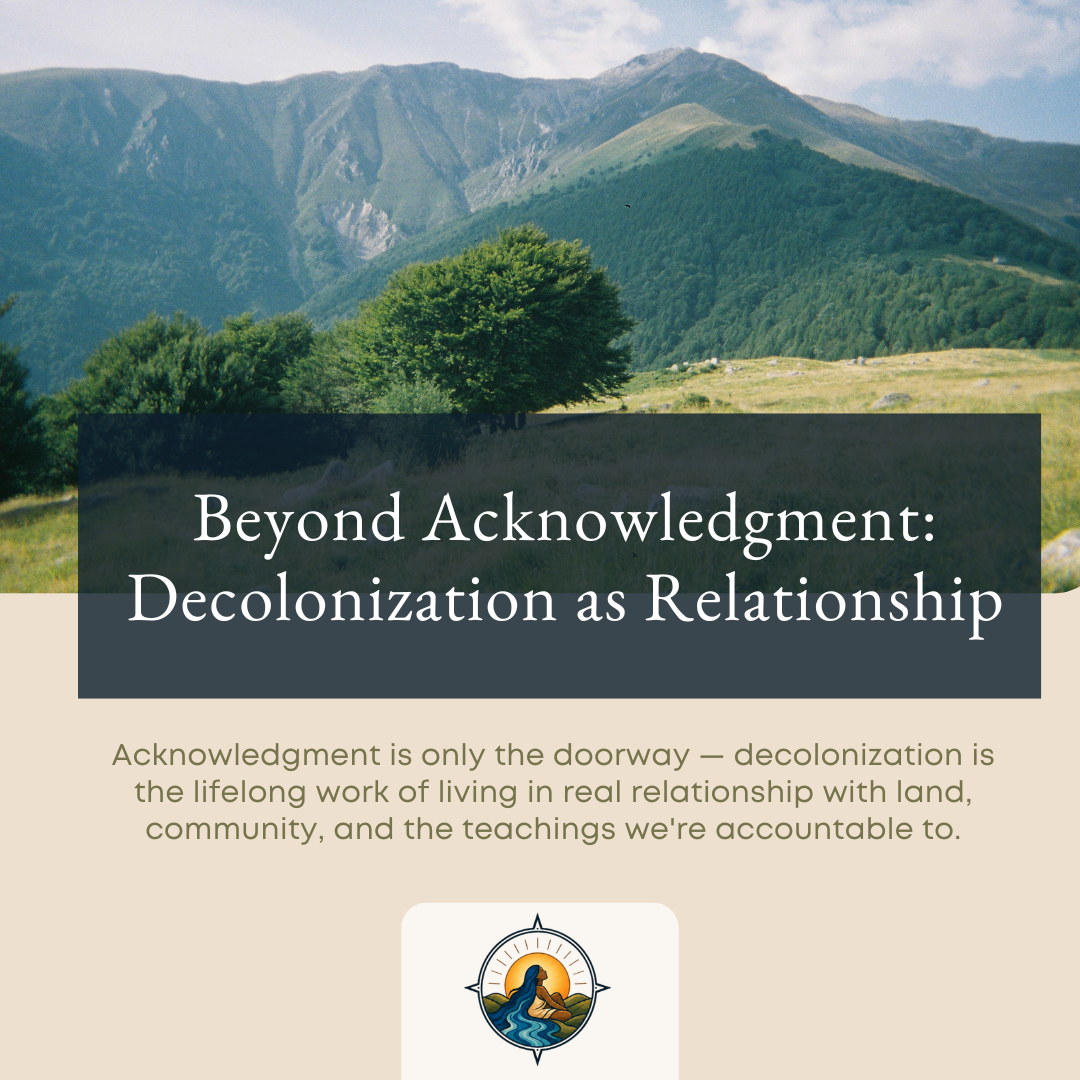
This series starts with a demanding idea: acknowledgment is only the doorway. The real work is learning to live in relationship.
To go beyond acknowledgment is to accept that land, history, community, and healing aren’t abstractions. They’re responsibilities. And if we’re willing to listen, they’ll teach us how to become better relatives.